


Retirement of the email-based BREQ_FAST service
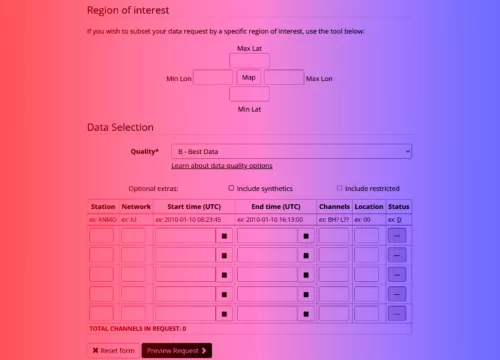
The BREQ_FAST request mechanism is being retired and will stop being supported by the EarthScope data management platform sometime between June 2024 and the end of the year.
Here in the News & Features section, you can find important announcements or learn more about our work and the science we support.
The BREQ_FAST request mechanism is being retired and will stop being supported by the EarthScope data management platform sometime between June 2024 and the end of the year.
In order to monitor compliance with the Nuclear-Test-Ban Treaty, the CTBTO is developing ways to verify nuclear explosions. A new benchmark dataset based on (non-nuclear) experiments is one example.
Wind-driven ocean waves beat on Earth’s seafloor, creating a continuous signal for which seismic stations around the world listen—a signal that is increasing.
The Columbia River has sawed its way to the sea as a mountain range grew up around it. There is history to be read in the walls of the gorge, including history of the mountains’ rise.
This year’s Board of Directors election is complete and the votes from consortium member representatives have been tallied. We have some incoming Board members to welcome, and others to thank!
Operational aspects of a portion of NSF-funded Global Seismographic Network (GSN) stations will be transitioned to EarthScope Consortium.
As the new cloud architecture for our data systems is taking shape, it’s time to start sharing information about the new capabilities that will become available.
Students gain an authentic scientific experience by exploring large, real-world datasets and building coding skills with GeoCode’s educational modules.
To facilitate calibration of InSAR ground displacement measurements, NASA JPL corner reflectors have been deployed next to NOTA stations along the San Andreas Fault. Check out this video to learn more!